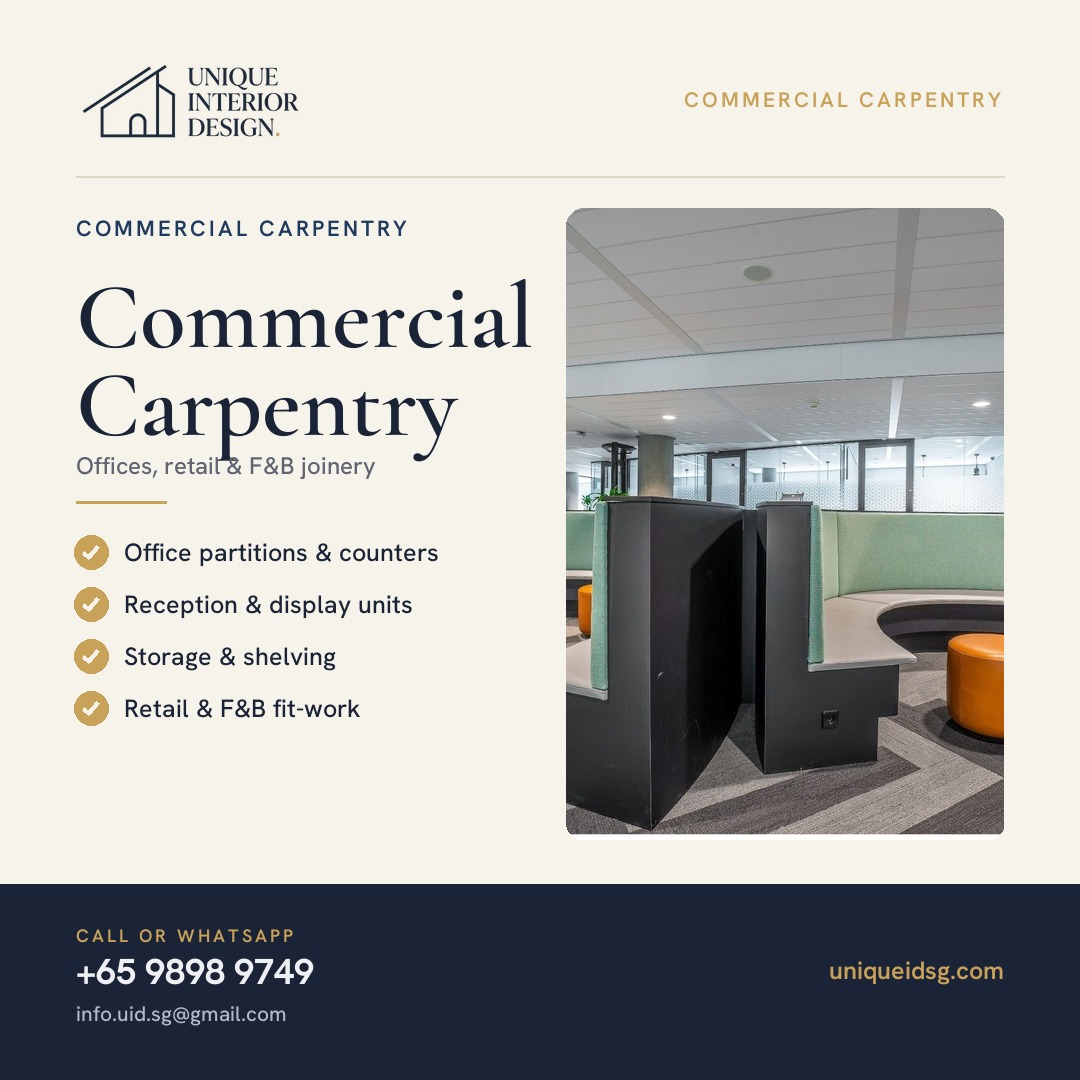
Commercial Carpentry Services in Singapore
Introduction
Commercial carpentry services are a core component of interior renovation projects in Singapore. Unlike residential carpentry, commercial carpentry encompasses large-scale installations, strict compliance requirements, precision workmanship, and integration with multiple building systems. From office partitions and reception counters to custom joinery and retail display fittings, commercial carpentry plays an essential role in achieving functional, durable, and visually coherent spaces.
Singapore’s competitive commercial environment demands tailored carpentry solutions that support brand identity, enable workflow efficiency, and meet the performance requirements of modern workplaces, retail outlets, F&B establishments, clinics, and corporate facilities.
This article outlines the scope of commercial carpentry services in Singapore, key considerations, common applications, quality standards, and how to select a contractor capable of delivering reliable results.
What Are Commercial Carpentry Services?
Commercial carpentry refers to custom woodwork, joinery, and carpentry installations designed for business environments. Services include:
- Built-in cabinetry for offices and retail outlets
- Custom joinery for showrooms, counters, and display units
- Reception desks and feature walls
- Partition systems and ceiling carpentry
- Conference room millwork and storage solutions
- Fitted cabins and meeting pods
- Wall panelling and architectural woodwork
- Commercial shelving and fixtures
These installations require advanced technical skills, structural coordination, material expertise, and an understanding of space planning principles.
Why Commercial Carpentry Matters for Business Spaces
Commercial carpentry impacts both function and perception. High-quality carpentry work contributes to:
1. Brand Identity and Professionalism
Well-designed and finely finished joinery reflects a business’s professionalism and attention to detail. Retail fixtures, reception counters, and feature walls contribute to how clients perceive a brand.
2. Space Efficiency
Commercial carpentry maximises usable space through customised solutions such as built-in storage, concealed compartments, and modular workstations. Efficient use of space improves workflow and staff productivity.
3. Durability and Maintenance
Commercial environments experience high footfall and frequent use. Professional carpentry uses durable materials and precise joinery techniques that withstand wear and tear over time.
4. Technical Compliance
Commercial carpentry must integrate with fire safety systems, accessibility standards, and building regulations. Contractors with commercial experience ensure compliance and safety.
5. Functional Workflow
Furniture and fittings designed with ergonomic and operational considerations improve workflow and reduce fatigue—for example, efficient meeting room layouts and storage systems tailored to specific organisational needs.
Key Components of Commercial Carpentry Services
1. Custom Joinery & Built-In Furniture
Commercial projects often require custom joinery, including:
- Reception counters
- Built-in shelving and cabinetry
- Office storage and filing systems
- Retail display units
- Mall kiosks
Custom joinery is measured, manufactured, and installed to exact site specifications, ensuring seamless integration with architectural elements.
2. Partition Walls & Office Renovation
Flexible and modular partition solutions allow businesses to:
- Create enclosed offices
- Configure open workspaces
- Install glass partitions for visual transparency
- Integrate acoustic panels for noise control
Partition systems must be structurally stable and coordinated with mechanical and electrical services.
3. Ceiling & False Ceiling Carpentry
Commercial carpentry includes detailed ceiling and soffit works:
- Drop ceilings for lighting and HVAC integration
- Feature ceilings for design emphasis
- Concealed service routes for wiring and cabling
Ceiling carpentry contributes to spatial volume and aesthetic refinement.
4. Reception & Feature Areas
Reception counters and feature walls often serve as focal points in commercial spaces. These installations require:
- Precision joinery
- Premium finishes
- Brand colour integration
- Material contrasts for visual impact
Such presents a strong first impression for visitors and clients.
5. Specialty Fittings
Depending on the sector, commercial carpentry may involve:
- Display shelves for retail outlets
- Storage units for clinics
- Cabinets for laboratories
- Bars and seating structures for F&B
Each application must be designed for both durability and compliance with industry requirements.
Materials Used in Commercial Carpentry
Material selection in commercial carpentry balances aesthetics, durability, and maintenance.
Common materials include:
Wood & Engineered Wood
- Plywood (MR Grade, BWR Grade)
- MDF (Medium-Density Fibreboard)
- Solid timber
- Laminated timber
Engineered wood offers dimensional stability and uniform finish.
High-Pressure Laminates (HPL)
A durable surface finish used for cabinetry, panels, and worktops. HPL resists scratches, stains, and moisture, making it ideal for high-use environments.
Acrylic & PVC Panels
Acrylic and PVC panels provide premium finishes and a glossy appearance for feature areas. They are easy to clean and suitable for reception counters and display units.
Metal & Glass Components
In modern commercial interiors, carpentry often integrates metal framing and glass panels for partitions, shelving supports, and architectural accents.
Specialty Surfaces
- Veneers for a natural wood look
- Stone or quartz worktops for heavy-use counters
- Painted finished MDF for customised colour schemes
Material selection must align with design intent, budget, and maintenance expectations.
Commercial Carpentry Installation Process
1. Site Measurement & Survey
Accurate on-site measurements are essential. A detailed survey identifies:
- Ceiling and floor dimensions
- Obstructions such as columns and services
- Finishing tolerances
- Integration points with M&E systems
This data informs cabinetry fabrication and installation planning.
2. Design & Shop Drawings
Professional carpentry services include detailed design and shop drawings. These illustrate:
- Cabinet layouts
- Joint details
- Finishing schedules
- Material specifications
Shop drawings ensure that all parties share a clear vision of the final installation.
3. Fabrication in Workshop
Once designs are approved, joinery is manufactured in a controlled workshop setting:
- Precision cutting
- Edge banding and surface finishing
- Pre-assembly quality checks
- Component labelling
Fabrication in a workshop minimises on-site disruption.
4. On-Site Installation
Installation is coordinated with other trades:
- Mechanical & electrical services
- Tiling and flooring works
- Ceiling and partition installations
- Painting and finishing
Commercial carpentry requires precision alignment, secure fixings, and quality checks on every joint and surface.
5. Final Inspection & Handover
Before project completion, a final inspection ensures:
- Accurate alignment and fitment
- Smooth operation of drawers and doors
- Uniform surface finishes
- Compliance with contract specifications
Reliable contractors provide comprehensive handover documentation and after-service support.
Quality Standards in Commercial Carpentry
Commercial carpentry in Singapore must meet high standards of workmanship:
1. Structural Strength
Cabinetry and partitions must withstand dynamic load conditions typical of commercial use.
2. Finishing Consistency
Colour and surface finishes must exhibit uniform quality across all components.
3. Precise Alignments
Drawers, doors, and panels must align with millimetre precision to ensure functionality and aesthetics.
4. Compliance with Safety Standards
Carpentry must integrate with fire safety, accessibility, and building regulations in commercial spaces.
Selecting a Commercial Carpentry Contractor in Singapore
When choosing a commercial carpentry provider, consider:
1. Relevant Experience
Look for contractors with a proven track record in office, retail, F&B, healthcare and corporate spaces.
2. Design & Technical Capability
The contractor should provide design support, material advice, and technical coordination.
3. Transparent Costing
Detailed quotations with breakdowns for materials, labour, installation, and after-care services.
4. Quality Assurance
Seek assurances on:
- Material sourcing
- Workmanship warranty
- After-installation service support
5. Project Management
Holistic project coordination ensures carpentry integrates seamlessly with other renovation components.
Conclusion
Commercial carpentry services in Singapore are essential for creating functional, durable, and visually cohesive business environments. From custom joinery and partitions to reception counters, feature walls, and specialty fixtures, professional carpentry contributes significantly to operational efficiency and brand presentation.
Engaging a qualified commercial carpentry contractor ensures accurate design, quality materials, precise fabrication, and seamless installation. With careful planning, technical expertise, and adherence to standards, commercial carpentry elevates interior spaces and supports long-term performance.
For comprehensive commercial carpentry and renovation services across Singapore, Unique Interior Design Pte Ltd delivers professional design, precision craftsmanship, and reliable project execution tailored to your business needs.
Planning a project?
Get a free, no-obligation quote from the team that does the work.
Chat on WhatsApp